When you feel anxious or stressed, your body is in a state of high alert. Your heart pounds, your breath gets shallow, and your mind races with a thousand thoughts. This is your "fight-or-flight" (sympathetic) nervous system taking over. You can't just "think" your way out of it. You need a tool that speaks to your body. Yoga for anxiety and stress is that tool.
It is a powerful, science-backed practice that directly calms your nervous system and quiets your mind. This is how you can use your mat as a sanctuary.
Your nervous system has two main modes:
Sympathetic (The Gas Pedal): This is your "fight-or-flight" response. It releases cortisol and adrenaline, tensing your muscles and speeding your heart rate. We live here most of the time.
Parasympathetic (The Brake Pedal): This is your "rest-and-digest" response. It calms the body, slows the heart rate, and tells your brain you are safe.
Yoga is one of the most reliable ways to manually hit the "brake pedal." It does this by stimulating the vagus nerve, the main pathway of your parasympathetic system, and by boosting your brain's levels of GABA, a neurotransmitter that acts as a natural anti-anxiety "off" switch.
The fastest way to calm your nervous system is to change your breath. Anxious breathing is fast and shallow. Calm breathing is slow and deep. In yoga, this breath control is called pranayama.
This ancient practice is proven to balance the left and right hemispheres of the brain and immediately induce a state of calm.
Sit comfortably. Take your right hand and fold your index and middle fingers down. You will use your thumb and ring finger.
Gently close your right nostril with your thumb.
Inhale slowly through your left nostril.
Close your left nostril with your ring finger (so both are closed) and hold the breath for a moment.
Release your thumb and exhale slowly through your right nostril.
Inhale through that same right nostril.
Close the right nostril, hold for a moment.
Release your ring finger and exhale through the left nostril. That is one full round. Continue for 2-5 minutes.
When you are anxious, the goal is not a high-powered, sweaty workout. The goal is to be grounded and restored. Focus on these poses.
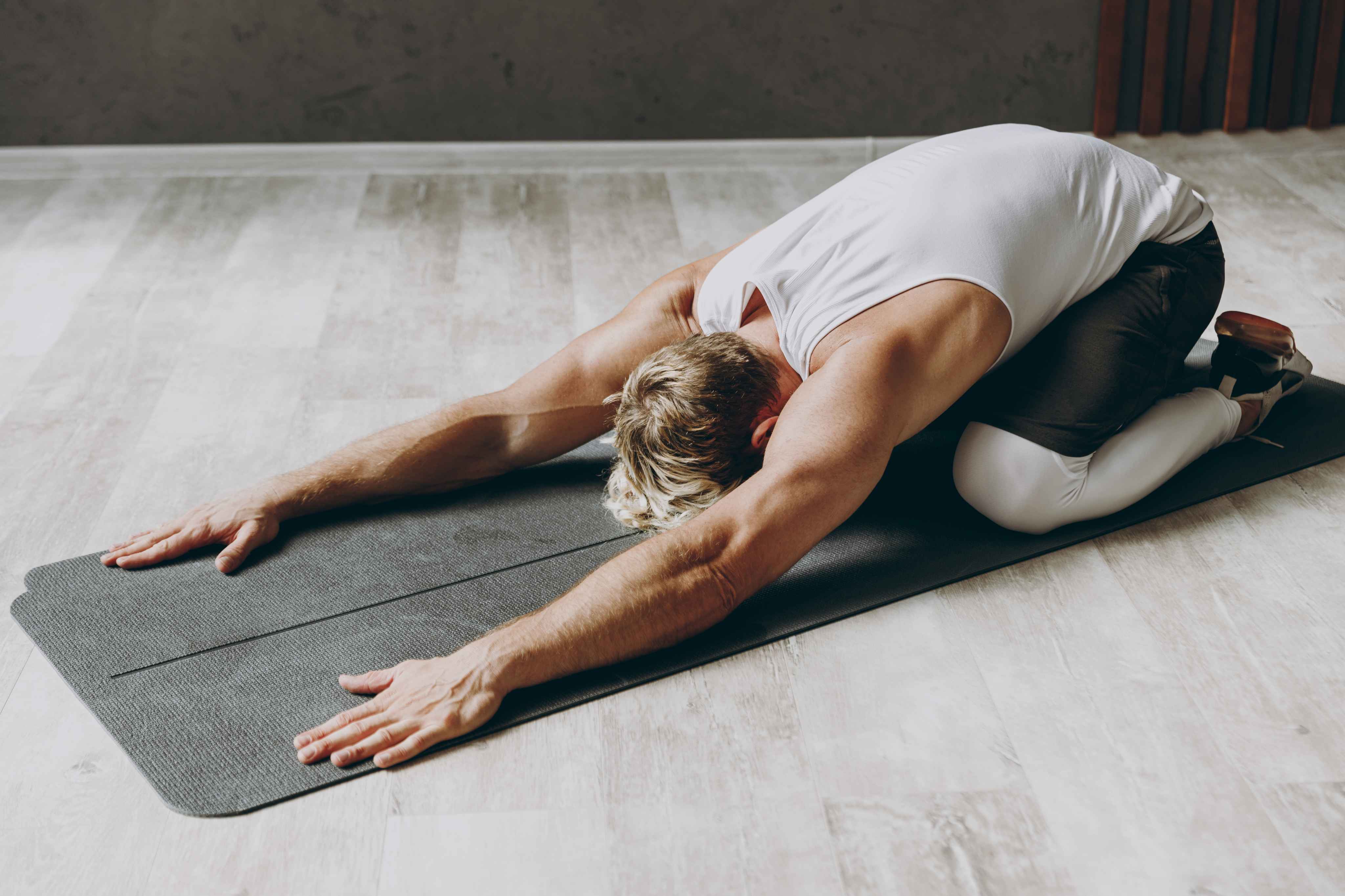
Why: This is the ultimate "safe" pose. It's an internal, grounding pose that blocks out external stimulation. The gentle pressure of your forehead on the mat can be deeply comforting and helps to calm the mind.
How to perform this Yoga exercise for anxiety: Kneel on your mat, sit your hips back to your heels, and fold your torso forward, resting your forehead on the floor. Let your arms rest by your sides, palms up.
Why: This is the gold standard for stress relief. By inverting the legs, you reverse blood flow, which helps to calm your heart rate and lower blood pressure. It is a completely passive way to trigger your "rest-and-digest" response.
How does it work for anxiety: Sit sideways against a wall, then swing your legs up the wall as you lie back. Let your arms rest open. Close your eyes and stay for 5-10 minutes.
Why: Forward folds are naturally introspective and calming. This pose provides a deep stretch for your entire backside (hamstrings, spine), releasing physical tension.
How: Sit on the floor with your legs straight out. Inhale to sit tall, and exhale to hinge from your hips (not your waist) and fold forward. Don't worry about touching your toes; just let your head hang heavy.
Why: This is the most important part of a yoga practice for anxiety. It is the practice of complete surrender, which means doing nothing but indulging in being. It trains your body and mind that it is safe to fully relax.
How: Lie flat on your back. Let your feet fall open and your arms rest by your sides, palms facing up. Close your eyes and simply focus on the sensation of your breath.
Your yoga mat is a laboratory for your life. It is a safe place to practice being present, to breathe through discomfort, and to learn how to be the calm, steady center of your own storm. You don't need to be an expert. You just need to show up, breathe, and give yourself permission to be still.
How to Build an Exercise Habit That Lasts Starting a new exercise routine is often the...
Read More
Desk Job? Simple Stretches to Counter Sitting All Day For many people, the workday...
Read More
The Basics of Strength Training for Beginners Strength training is sometimes seen as...
Read More
The Power of a Daily Walk: Small Steps, Big Benefits Of all the forms of exercise...
Read More